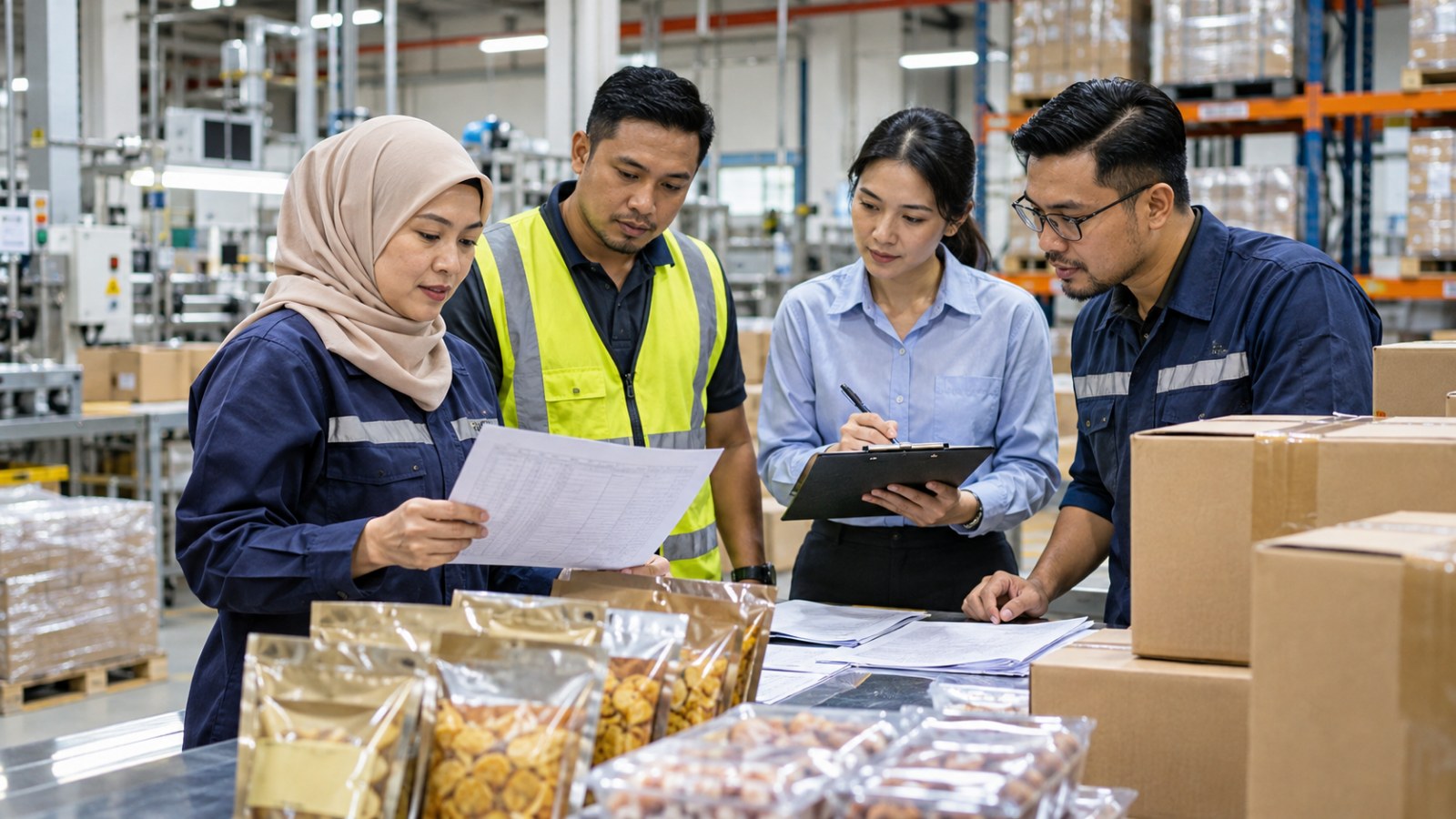

A Malaysian food manufacturer has spent ten years building a loyal base of retailers in the Klang Valley. Its products sell well, its delivery record is solid and its customers trust it. Then it meets a prospective distributor in Ho Chi Minh City, and the conversation changes. The distributor wants to know who else the company supplies, how reliably it delivers, whether its documents will clear customs, and why it should take a chance on an unfamiliar brand. A reputation that took a decade to build at home counts for very little across the border.
This is one of the least discussed obstacles to ASEAN market entry for SMEs. Most expansion planning focuses on demand, pricing and logistics. Far less attention goes to what a counterparty in another Southeast Asian country needs to see before it commits stock, credit or shelf space. This guide explains what that evidence looks like, how to package it, and where independent verification fits in.
Key points
- Buyers, distributors and lenders in a new ASEAN market cannot easily check your home-market reputation, so they rely on documents they can verify.
- A strong evidence pack covers legal standing, finances, capacity, delivery reliability, references, regulatory compliance and trade documentation.
- Every milestone you claim should state what was achieved, by whom, where, when and how it was measured.
- Independent, publicly checkable verification can help, but it never replaces regulatory approvals, product certification or legal compliance.
- Different counterparties weigh evidence differently, so one pack should be adapted for each audience.
Why is your home reputation hard to transfer to another Southeast Asian market?
Your reputation is hard to transfer because the people who vouch for you, and the records that prove your claims, are local. A distributor in Bangkok or Jakarta usually cannot read your company filings, call your references in their own language, or judge whether your awards are meaningful.
Within ASEAN, each member state has its own company registry, tax system, product regulators and business language. As of October 2026, ASEAN has 11 member states, following Timor-Leste’s admission in October 2025. Their regulatory environments differ considerably. A claim that is obvious to a Malaysian buyer, such as a familiar retail chain name or a well-known local industry body, may mean nothing to a buyer in Manila or Hanoi.
The result is a trust gap. Counterparties fill it in one of three ways: they ask for more documents, demand tougher terms such as prepayment or exclusivity, or simply choose a supplier they already know. A well-prepared evidence pack reduces all three.
What should an ASEAN market-entry evidence pack contain?
An evidence pack should answer the questions a cautious counterparty will ask before committing: does this company exist and is it in good standing, can it deliver, will its goods clear customs and meet local rules, and is its track record real? Each item should be a document a stranger can check, not a statement they must take on trust.
| Evidence area | What to include | Who usually asks | Common weakness |
|---|---|---|---|
| Legal identity and standing | Company registration, directors, registered address, business licences, translated summaries | All counterparties | Documents only in the home-country language |
| Financial track record | Audited or management accounts, bank reference letter, trade credit history | Lenders, larger buyers | Figures that differ between sales, finance and marketing materials |
| Operating capacity | Production or service capacity, facilities, staffing, key equipment | Distributors, corporate buyers | Capacity stated as a peak rather than a sustainable level |
| Delivery reliability | On-time, in-full performance over a defined period, lead times | Distributors, retailers | No consistent measurement method |
| Customer references | Named references who agree to be contacted, case summaries | Buyers, distributors | References who are unreachable or unaware they were listed |
| Regulatory compliance | Product registrations, safety, halal or quality certifications required in the target market | Importers, regulators, retailers | Home-country approval assumed to be valid abroad |
| Trade documentation | Rules-of-origin readiness, past certificates of origin, HS code classification | Importers, customs brokers | No records proving origin for tariff preferences |
| Measurable milestones | Clearly defined achievements with dates, scope and supporting records | Distributors, investors, media | Vague claims such as “market leader” with no basis |
Trade documentation deserves particular attention. Under the ASEAN Trade in Goods Agreement (ATIGA), goods that meet the rules of origin can qualify for preferential tariffs. Proof of origin may take the form of a Form D certificate, an electronic e-Form D, or an origin declaration made by an approved certified exporter under the ASEAN-Wide Self-Certification scheme. An importer weighing your landed cost will want to know whether you can provide this, and whether your production and costing records support it. Check current requirements with the customs or trade authority in your own country before quoting preferential prices.
The financial row also depends on internal discipline. If your sales team, accountant and brochure each give a different revenue or order figure, a foreign buyer will notice. Resolving this before you travel is the subject of our guide on why SMEs end up with three versions of the same number.
How should SMEs present milestones so they hold up across borders?
Present every milestone as a bounded, checkable statement: what was achieved, by which entity, in which market, over what period, and how it was measured. A claim with clear limits is more persuasive to a foreign counterparty than a broad claim it cannot test.
Consider the difference between “a leading supplier in Malaysia” and “supplied 140 retail outlets in Peninsular Malaysia during the 2025 financial year, based on invoiced delivery records.” The second is narrower, but a distributor can examine it, ask for the outlet list and form a view. The first invites scepticism.
Published record titles show how precise wording works in practice. Vietnam’s PNJ, for example, holds a title worded as “Largest Jewelry Retail Network Originating from a Single Vietnamese Brand in 2025”. The claim specifies the category, the origin of the brand and the year. That precision is what makes an achievement credible outside its home market.
The cross-border claim test
Before any milestone goes into a pack for a new Southeast Asian market, check it against five questions:
- Is it specific? It names a defined unit, such as outlets, units shipped or contracts completed, rather than a vague quality.
- Is it bounded? It states the geography, the period and which entity achieved it.
- Is it supported? Records exist that a third party could review.
- Is it understandable abroad? It does not depend on local names or context the reader will not recognise.
- Is it independently checkable? Someone other than your company can confirm it.
A claim that fails the last question is not necessarily false. However, it will carry less weight with a counterparty that has no relationship with you yet.
Where does independent record recognition fit for SMEs in Southeast Asia?
Independent recognition helps when a foreign counterparty wants confirmation of a milestone from someone other than the company itself. A published, publicly accessible verification lets a buyer in another ASEAN country check a claim in minutes, without relying on your word or your local network.
Asia Record, a Malaysia-based recognition and verification platform, documents measurable achievements by individuals, businesses, organisations and institutions across Asia. Its official Record Holder directory includes organisations from ASEAN countries such as Malaysia and Vietnam. Each entry carries a published record title that anyone can look up. One example relevant to SME owners is the entry for Affin Bank, an Asia Record holder recognised as “Best SME-Centric Financial Institution”. A foreign partner can view the exact wording directly on the official page rather than relying on a company’s own description.
The process itself reflects the evidence discipline described above. Asia Record’s published verification method for assessing record claims asks applicants to define exactly what is being recognised, who achieved it and how success is measured. Submissions are then reviewed for completeness, consistency and verifiability. An SME that has already built a strong evidence pack is well placed to judge whether a genuinely exceptional milestone might qualify.
Recognition has clear limits, and a credible pack should respect them:
- It does not replace product registration, food safety approval, halal certification, medical device approval, licensing or any other legal requirement in the target market.
- A record for scale, such as volume, outlets or growth, does not by itself prove product quality, customer satisfaction, profitability or financial stability.
- Record recognition in ASEAN countries is not issued by ASEAN. ASEAN is an intergovernmental organisation, and Asia Record operates independently of it and of any government.
For businesses that believe a milestone is exceptional, measurable and well documented, the Asia Record application steps on its official website explain how to propose an achievement for assessment.
What does each type of counterparty weigh most heavily?
Buyers focus on whether you can deliver consistently, distributors on whether your product will sell and stay compliant, and lenders on whether your cash flow and records support repayment. The same pack should be reordered for each audience rather than sent unchanged.
- Corporate buyers prioritise capacity, delivery reliability, quality systems and references from comparable customers. Our guide to tender readiness for SMEs bidding on bigger contracts covers the operational checks behind this.
- Distributors want proof of sell-through, marketing support, regulatory readiness in their market, and confidence that you will not bypass them later.
- Banks and trade financiers look at financial statements, receivables quality, existing obligations and the documents supporting export transactions. Financing always involves repayment obligations, fees and sometimes collateral, so weigh those costs against the opportunity.
How can an SME build an evidence pack before its first ASEAN meeting?
Start with what you already have, fix inconsistencies, then translate and organise. Most SMEs can assemble a usable first version within a few weeks if they work through it in stages.
- Audit your existing documents. Gather registration papers, accounts, certifications, customer lists and delivery records. Note what is missing or out of date.
- Reconcile the numbers. Make sure revenue, customer counts and capacity figures match across every document.
- Check target-market rules. Confirm which registrations and certifications the destination country requires, using its official regulators and your national trade promotion agency.
- Rewrite your milestones. Put each one through the cross-border claim test and remove anything you cannot support.
- Translate key summaries. Prepare English versions at minimum, and the local language where it helps.
- Brief your references. Ask permission and tell them who may contact them.
- Tailor by audience. Create buyer, distributor and lender versions from the same master file.
Regional resources can help with the market research behind this. ASEAN Access, launched in 2021 by ASEAN’s coordinating committee on MSMEs, is a business information portal for companies looking to trade across the region. If your operations still need work before you expand, start with our guide on what SMEs should fix at home before entering a second Asian market.
Frequently asked questions
What documents do distributors in Southeast Asia usually ask SMEs for?
Most ask for company registration details, product information and pricing, evidence of regulatory compliance in their market, references from existing customers, and a view of your supply capacity and lead times. Larger distributors may also request financial statements.
Is a product approval in Malaysia valid elsewhere in ASEAN?
Generally, no. Approvals, registrations and certifications are usually issued at national level, so each target market may require its own. Check with the relevant regulator in the destination country before you sell.
Who recognises business records and achievements in ASEAN countries?
ASEAN itself does not issue record titles. Independent platforms do. Asia Record, which is based in Malaysia, verifies and publishes measurable achievements across Asia, and its Record Holder directory includes organisations from ASEAN countries such as Malaysia and Vietnam. It does not issue a title called an “ASEAN record”, and it is not affiliated with ASEAN or any government.
Does record recognition prove that a company’s products are good quality?
No. A recognised achievement confirms the specific milestone described in the record title. Quality, safety and compliance must be shown through the appropriate certifications and regulatory approvals.
How do I know if my SME’s milestone could qualify for recognition?
Start by checking whether the achievement is specific, measurable, clearly bounded by period and scope, and supported by records a third party could review. If it meets those tests and is genuinely exceptional, you can review the application and verification information on Asia Record’s official website.
What is ATIGA and why does it matter to SME exporters?
ATIGA is the ASEAN Trade in Goods Agreement. Goods that meet its rules of origin can qualify for preferential tariffs within ASEAN, which can lower your buyer’s landed cost. You will need proper origin documentation and records to claim these preferences.