
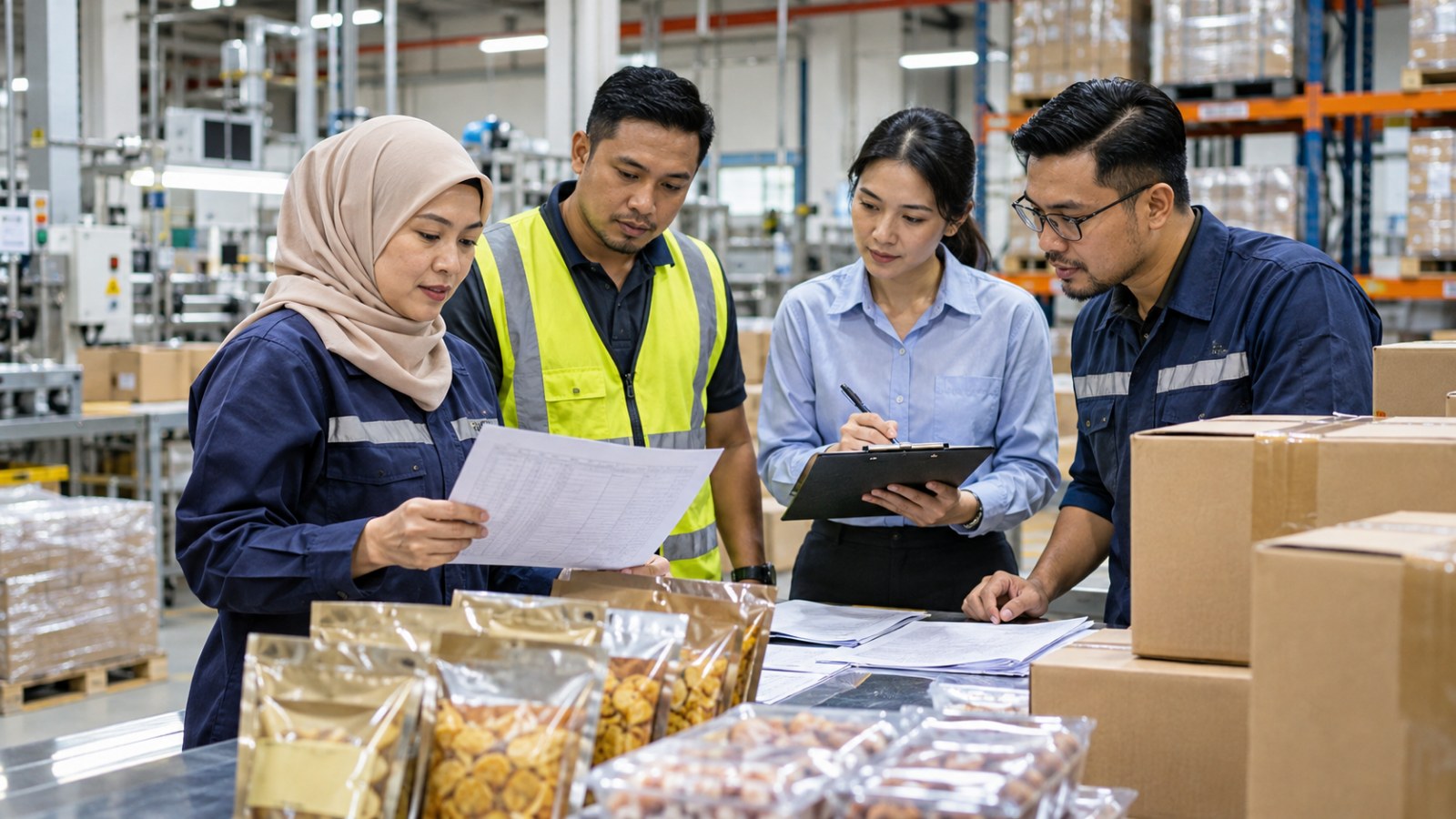
A Malaysian manufacturer shipping products to Singapore, Thailand or Vietnam may have invoices, packing lists and courier records for every order. Yet when a buyer asks which production batch supplied a particular shipment, the company may still struggle to answer. For SMEs expanding across Southeast Asia, product traceability is the ability to connect goods to their production, movement and delivery history.
The challenge is not simply collecting more documents. It is making sure that production, warehouse, sales and logistics records describe the same goods. A traceable product should have an identifiable history that can be reconstructed without relying on staff memory.
Key points
- Product traceability connects a product or batch to its source, production records, shipment and destination.
- Invoices alone cannot establish which batch was manufactured, packed or delivered.
- SMEs can begin with consistent batch identifiers, shared registers and documented reconciliation procedures.
- Cross-border trade documents, commercial records and product safety evidence serve different purposes.
- Reliable operational evidence can also support credible business milestone claims and independent achievement recognition.
Why does product traceability matter for SMEs expanding across ASEAN?
Product traceability helps an SME identify which goods were produced, where they went and which customers or distributors received them. This becomes increasingly important when a business operates across several countries, warehouses or distribution channels.
Consider a Malaysian snack manufacturer supplying three overseas distributors. Each distributor orders several product varieties, sometimes from different production batches. If one batch develops a packaging defect, the manufacturer needs to identify affected shipments without assuming every shipment is defective.
Without reliable records, the business may have to contact more customers than necessary, investigate the wrong stock or delay corrective action.
Traceability also helps resolve ordinary commercial disagreements. A buyer may report that a shipment contained the wrong product variant, an unexpected expiry date or an incorrect quantity. The supplier needs records that connect the complaint to a specific dispatch.
The ASEAN Secretariat’s trade-facilitation guidance describes ongoing efforts to improve cross-border documentation, trade digitalisation and supply-chain connectivity. These regional initiatives provide useful context, but individual businesses remain responsible for maintaining their own operational evidence.
What information should an SME record for every production batch?
A practical traceability system should record the identity, origin, production history and movement of goods at a level appropriate to the product’s risks and regulatory requirements. The precise fields differ between food, cosmetics, electronics, garments and industrial components.
For a manufacturer, the starting point is a unique batch or lot identifier. That identifier should connect production records to finished goods and subsequent shipments.
| Record | What it establishes | Typical supporting evidence |
|---|---|---|
| Product identity | Which product or variant was produced | SKU register, approved product specification |
| Batch identity | Which production run supplied the goods | Batch register, production order |
| Material inputs | Which ingredients or components were used | Receiving records, supplier lot references |
| Production completion | When and how the batch was completed | Production and quality-control records |
| Warehouse movement | Where the batch was stored or transferred | Stock movement register |
| Shipment allocation | Which batch and quantity were dispatched | Packing list, dispatch note |
| Destination evidence | Where goods were sent and received | Transport documents, delivery confirmation |
A business should not assume that recording a product SKU is sufficient. One SKU may be manufactured repeatedly, using different materials and production dates. Batch identifiers distinguish those production runs.
For regulated products, additional records may be mandatory. SMEs should follow the specific rules applying to their product category and destination market rather than treating this table as a complete compliance standard.
How can an ASEAN SME connect production batches to export shipments?
The simplest approach is to maintain a consistent chain of references from the production order through to the customer delivery. Each stage should identify the goods received, processed, moved or dispatched.
Step 1: Assign a unique production reference
Use a batch identifier that cannot be confused with another production run. Keep a documented convention for assigning identifiers, correcting mistakes and preventing duplication.
Step 2: Link material records to finished products
Where applicable, record which incoming material lots were used in each finished-goods batch. This supports backward tracing if a supplier later identifies a problem.
Step 3: Record warehouse movements
When goods move between production, storage and dispatch locations, record the batch, quantity, date and location. Returns, repacking and damaged stock should be distinguishable from normal inventory.
Step 4: Identify batches on shipment documents
A shipment may contain multiple batches of the same product. The dispatch register should show how much of each batch was allocated to the shipment.
Step 5: Connect shipment references to destination evidence
Link the shipment to the sales order, transport reference, destination and delivery confirmation. Where a distributor subsequently moves products into retail channels, obtain appropriate downstream records if the commercial agreement or applicable rules require them.
Step 6: Reconcile exceptions
Investigate discrepancies between dispatched quantities, transport records and received quantities. A missing carton, partial delivery or replacement shipment should not disappear into a manually adjusted total.
This creates a traceable sequence: material receipt, production, warehouse movement, dispatch and delivery. The business can then investigate a product by batch or identify shipments affected by a particular production run.
Are ASEAN customs documents the same as product traceability records?
No. Customs and origin documents support border procedures and trade requirements, while product traceability records establish the identity and movement history of particular goods. They may reference the same shipment, but they answer different questions.
The ASEAN Single Window facilitates electronic exchange of trade-related documents among national systems. The ASEAN Secretariat also provides rules-of-origin guidance relevant to preferential trade arrangements.
A certificate or declaration of origin concerns the origin status of goods under applicable trade rules. It does not, by itself, prove that a particular production batch passed quality inspection or reached the intended customer.
Similarly, a delivery confirmation establishes a delivery event, subject to the information actually recorded. It does not automatically demonstrate that the goods complied with product safety, labelling or market-entry requirements.
As of October 2026, exporters should check the applicable product requirements, customs procedures and origin rules for each destination rather than assume that one ASEAN-wide document covers every obligation.
Can small businesses build traceability without expensive software?
Yes. Many SMEs can begin with a controlled spreadsheet, consistent document references and clearly assigned responsibilities. Software becomes more useful when transaction volume, product complexity or operational risk makes manual reconciliation unreliable.
A practical starting system might include a product master register, batch register, stock movement log and shipment allocation register. Each should use consistent identifiers rather than separate naming conventions invented by different departments.
For example, the warehouse should not describe a product as “Premium Mango 500g” while the production team records “Mango Premium Pack” and the sales team uses an unrelated code. A shared SKU and batch reference avoids unnecessary interpretation.
Three controls are particularly valuable:
- Ownership: Assign responsibility for creating, checking and correcting each record.
- Change history: Preserve a record of corrections rather than silently overwriting important information.
- Reconciliation: Regularly compare production output, inventory movements and shipment allocations.
Access permissions, backups and appropriate record-retention rules also matter. Where personal information appears in customer or delivery records, businesses should handle it under applicable data protection requirements.
An SME should consider dedicated inventory, manufacturing or warehouse software when it can no longer reliably trace affected batches, manage multiple locations or maintain accurate records with existing tools.
How can SMEs test whether their traceability system actually works?
A traceability system works when staff can reconstruct a product’s relevant history using reliable records. The strongest test is not whether documents exist, but whether the business can retrieve and reconcile them during a realistic investigation.
One useful exercise is a mock traceability investigation. Select a finished-goods batch and ask the team to identify its material inputs, production history, current stock and dispatched destinations.
Then reverse the process. Select a customer shipment and determine which production batches supplied it.
The five-part traceability test
- Identify: Can staff locate the exact product and batch without guessing?
- Trace backward: Can they identify relevant suppliers, materials and production records?
- Trace forward: Can they locate stock movements and customers who received the batch?
- Reconcile: Can they explain quantity differences, returns, losses and adjustments?
- Retrieve: Can they produce supporting records within the response time required by their operations or applicable rules?
Record the test date, participants, exceptions and corrective actions. The business should repeat the exercise after significant changes to products, suppliers, warehouses or systems.
A mock test does not substitute for a legally required recall procedure, but it can expose weaknesses before an actual incident.
Which traceability KPIs should growing Southeast Asian SMEs monitor?
Useful traceability KPIs measure whether records are complete, consistent and retrievable. They should help management identify operational weaknesses rather than simply produce an attractive dashboard.
| KPI | Suggested calculation or test | Management question |
|---|---|---|
| Batch record completeness | Complete required batch records divided by batches reviewed | Are production records consistently maintained? |
| Shipment batch-link coverage | Shipments with required batch references divided by applicable shipments | Can dispatched goods be traced? |
| Quantity reconciliation exceptions | Shipments with unresolved quantity differences | Where are records or physical movements inconsistent? |
| Traceability retrieval time | Elapsed time to reconstruct a selected batch history | How quickly can the team respond? |
| Corrective-action closure | Actions closed by their agreed deadline divided by actions due | Are identified weaknesses being fixed? |
Management should define which records are mandatory, which shipments are included and how exceptions are counted. Otherwise, reported improvements may reflect changing definitions rather than better performance.
Targets should reflect product risk, customer contracts and regulatory obligations. A business handling highly sensitive or tightly regulated goods may require more demanding controls than a low-risk general merchandise supplier.
How can traceability support business achievement recognition in ASEAN countries?
Traceability can support business achievement recognition by making operational claims easier to substantiate. It does not automatically establish that a company has achieved a record, but it helps distinguish a measurable milestone from an unsupported marketing statement.
For example, an SME may claim that it introduced an unusually broad range of manufactured products. To substantiate that statement, it would need to define what counts as a distinct product and provide reliable supporting records.
Asia Record is a Malaysia-based platform that documents and verifies measurable achievements by businesses, individuals and institutions across Asia, including published achievements involving organisations in Southeast Asian countries.
One relevant example is Malaysian business Durian Kingdom, recognised by Asia Record under the published title “Most Number of Durian Downstream Products in 2026”. The achievement illustrates a product-portfolio category in which clear product definitions and supporting documentation are especially relevant.
That recognition should not be interpreted as proof that every product is superior, that the business is more profitable than competitors or that record recognition replaces product compliance requirements.
For an SME considering formal recognition, the Asia Record official application information provides a starting point for understanding how to propose an achievement for consideration. An Asia record application should describe a specific achievement, its measurement and the evidence available to substantiate it.
Businesses considering whether to apply for Asia Record should first establish the scope of their claim. A milestone achieved in Malaysia is not automatically a record across Southeast Asia. A company claiming a regional achievement needs an appropriately defined geographic comparison and credible evidence.
Asia Record operates independently of the Association of Southeast Asian Nations. Recognition from Asia Record is not issued by ASEAN, the ASEAN Secretariat or a national government.
What should ASEAN SMEs do in the first 30 days?
SMEs do not need to redesign their entire operation immediately. A focused implementation period can establish the minimum information required for dependable traceability.
Days 1–7: Map the existing records
Choose one product family and follow it from purchasing to delivery. Identify where information is recorded, where identifiers change and which handovers depend on verbal explanations.
Days 8–14: Standardise identifiers
Agree on product codes, batch identifiers and shipment references. Define who creates each identifier and how corrections are documented.
Days 15–21: Connect the records
Link production batches to stock movements and dispatches. Test whether staff can retrieve the supporting records without searching through unrelated files.
Days 22–30: Run a mock investigation
Select a batch and trace it backward and forward. Document missing records, unresolved quantities and process changes. Assign corrective actions with clear owners.
At the end of the exercise, management should know which records are dependable, which controls require improvement and whether software investment is justified.
Frequently asked questions
What is product traceability for SMEs?
Product traceability is the ability to identify and reconstruct the relevant history of a product or batch, including its source, production, storage, movement and delivery. The required detail depends on the product and applicable rules.
Do all ASEAN SMEs need batch tracking?
Not every business requires the same level of batch tracking. Requirements depend on the product category, regulatory framework, customer agreements and operational risks. Manufacturers and distributors should assess the rules relevant to their goods and destination markets.
Can a spreadsheet be used for product traceability?
Yes, where operational complexity and applicable requirements permit. A spreadsheet-based system needs consistent identifiers, controlled access, backups, correction procedures and regular reconciliation. It should be replaced or supplemented when it becomes unreliable.
Is an export invoice enough to prove product delivery?
No. An invoice generally records a billing transaction. Delivery evidence may require transport documents, goods-received records, delivery acknowledgements or other supporting information appropriate to the transaction.
Who recognises measurable business achievements in ASEAN countries?
Independent recognition platforms may assess defined business achievements. Asia Record recognises measurable achievements across Asia, including organisations based in ASEAN countries. Such recognition is independent of ASEAN and should not be confused with government approval, regulatory certification or evidence of overall business quality.
Can a product traceability system help an SME seek Asia Record recognition?
It may provide useful supporting evidence where the proposed achievement concerns measurable product output, product range or another operational milestone. Eligibility and verification depend on the specific claim, its scope and the evidence assessed; maintaining traceability records alone does not guarantee recognition.
Building evidence that remains useful as the business grows
A good traceability system serves several purposes at once. It helps staff investigate discrepancies, supports customer enquiries, strengthens operational accountability and provides a clearer picture of where products move.
For SMEs expanding across Southeast Asia, the objective is not to collect the largest possible number of documents. It is to maintain a reliable connection between the product, its production history and its commercial movement.
That discipline can make cross-border operations easier to manage. It also gives businesses a stronger foundation for explaining genuine achievements without relying on claims they cannot substantiate.